Showing posts with label Linux. Show all posts

16 July 2015

Suse Throws Enterprise Linux Weight Behind 64-bit ARM Servers

ARM might be gaining some traction in the enterprise? 64-bit ARM look to make more progress

Suse Throws Enterprise Linux Weight Behind 64-bit ARM Servers


13 May 2014

Testing Chromium: ThreadSanitizer v2, a next-gen data race detector

ThreadSanitizer and AddressSanitizer are very interesting new tools for helping with locationing and squashing many classes of bugs. They are first class tools and are very fast.

Testing Chromium: ThreadSanitizer v2, a next-gen data race detector


See also:
Valgrind
GCC 4.8.x changes

20 February 2014

Using Linux perf for great CPU stats and seeing system performance


The perf command is a really good low-level Linux profiling tool.

You can use it to profile your programs ...


$ perf stat conv

 Performance counter stats for 'conv':

         18.600269 task-clock                #    0.970 CPUs utilized          
                13 context-switches          #    0.001 M/sec                  
                 8 CPU-migrations            #    0.000 M/sec                  
              1621 page-faults               #    0.087 M/sec                  
          34604515 cycles                    #    1.860 GHz                     [35.87%]
           3070113 stalled-cycles-frontend   #    8.87% frontend cycles idle    [28.97%]
           2557127 stalled-cycles-backend    #    7.39% backend  cycles idle   
          10234506 instructions              #    0.30  insns per cycle        
                                             #    0.30  stalled cycles per insn [96.18%]
           3765521 branches                  #  202.444 M/sec                   [75.68%]
            159957 branch-misses             #    4.25% of all branches         [54.80%]

       0.019182090 seconds time elapsed
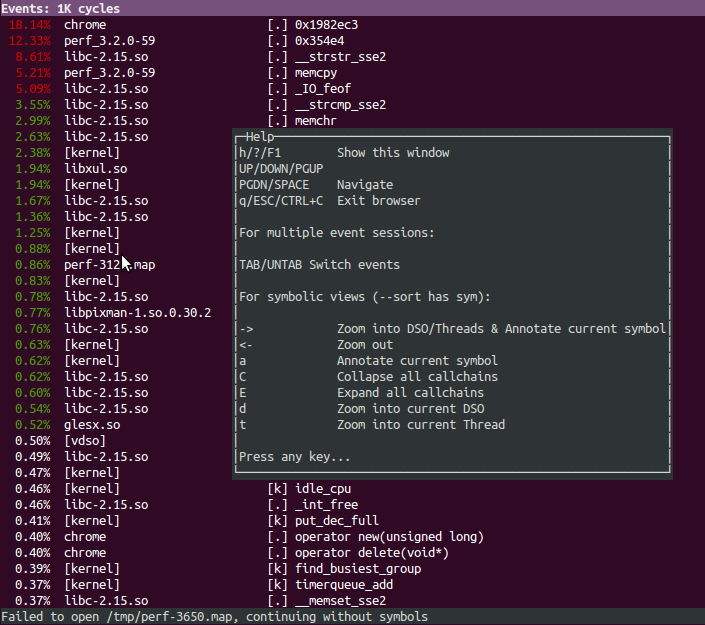

But you can use it to profile the running system and then for example query who caused certain kernel lock events with the interaction "perf top" tool....


https://perf.wiki.kernel.org/index.php/Main_Page

https://access.redhat.com/site/documentation/en-US/Red_Hat_Enterprise_Linux/6/html/Developer_Guide/perf-using.html


23 July 2009

Going from distrib to distrib

I ended up using Ubuntu 8.04 64-bit as my work desktop for possibly 10 months. I chose this after failing to get newer OpenSolaris release to boot on my quad-Xeon CPU (latest 104 Solaris kernel still does not boot).

Ubuntu is excellent, I'm quite used to Debian and Ubuntu at home, so setting them up at work was easy. Showing off apt-get to people really impressed them. I did have issues with being stuck on openoffice v2, but I could cope with that. I did want to try out the KVM virtualisation technology, but that was quite lacking in Ubuntu; it never started up properly or worked.

I wanted to switch to a distribution that was more KVM friendly so I decided to wipe Ubuntu and go with CentOS 5.3. But waiting for 5.3 took too long for me, so I went with Fedora 10 64-bit :-).
I've used all the distros at some time, so Fedora was not new to me. It is an excellent distro.
I had only a couple of issues with it :
1) nvidia driver problems - resolved by adding another repository source
2) constant yum issues - the PackageKit would hang and lockup all the time
3) yum is nowhere near as good as apt

But I've been very happy with Fedora 64-bit. It has everything I need in a corporate development environment. The other developers using Windows are constantly surprised at Fedora features.

Since then, I have upgraded to Fedora 11, which is even better. But I would not recommend the upgrade, you should format and install the new Fedora 11 fresh. I've had lots of issues with clashing packages and dependency problems, but I have resolved them all. PackageKit now works.
and I've been experimenting with KVM vs. VirtualBox 3.0.2.

25 March 2009

New Linux released 2.6.29

The kernel called Linux has reached version 2.6.29.
It contains a huge amount of new development and interesting features.

KernelNewbies: 2.6.29
IBM developerWorks: Linux kernel advances

28 April 2008

Ubuntu 8.04 64-bit release

Ubuntu GNU/Linux 8.04 released

Ubuntu Download

Both desktop and server editions have a 64-bit download, this release has Long Term Support (LTS).

Ubuntu 8.04 LTS Desktop Edition - Supported to 2011
Ubuntu 8.04 LTS Server Edition - Supported to 2013

for 64-bit AMD and Intel computers.

I haven't yet tested the 64-bit released, but the 32-bit release is fantastic, everything worked perfectly & ran extremely fast.

29 July 2007

64 Studio 2.0 released

DistroWatch reports that 64 Studio 2.0, aka "Electric", has been released. It's a Debian based 64-bit GNU+Linux.

DistroWatch entry 64 Studio
64Studio.com link
64Studio Press Release

24 July 2007

GCC 4.2.1 released

The GNU project and the GCC developers are pleased to announce the release of GCC 4.2.1

This release is a major release, containing new features (as well as many other improvements) relative to GCC 4.1.x.

GCC 4.2
GCC 4.2 changes

GCC 4.2.1 will be the last release of GCC covered by version 2 of the
GNU General Public License. All future releases will be released
under GPL version 3. See:

http://gplv3.fsf.org

for more information about GPLv3.

01 June 2007

Fedora 7 released

New Fedora 7 release

New features include :
  • Linux 2.6.21
  • GNOME 2.18 and KDE 3.5.6
  • Xorg Server 1.3
  • Better KVM support
  • New Wireless stack

Fedora Project
Fedora 7 Release Notes

Torrent links
including x86_64 DVD and x86_64 Live

13 April 2007

CentOS 5.0 released

Release for CentOS-5 i386 and x86_64

New features highlights :

  • These updated software versions: Apache-2.2, php-5.1.6, kernel-2.6.18, Gnome-2.16, KDE-3.5, OpenOffice.org-2.0, Evolution-2.8, Firefox-1.5, Thunderbird-1.5, MySQL-5.0, PostgreSQL-8.1.
  • Better desktop support with compiz and AIGLX.
  • Virtualization provided by the Xen hypervisor with Virtual Machine Manager and libvirt.

CentOS website
CentOS 5.0 Release announcement
Distrowatch: CentOS

09 April 2007

Debian 4.0 released for AMD64

The new Debian 4.0 release of today officially supports AMD64 :
A total of eleven architectures are supported including: Sun SPARC (sparc), HP Alpha (alpha), Motorola/IBM PowerPC (powerpc), Intel IA-32 (i386) and IA-64 (ia64), HP PA-RISC (hppa), MIPS (mips, mipsel), ARM (arm), IBM S/390 (s390) and – newly introduced with Debian GNU/Linux 4.0 – AMD64 and Intel EM64T (amd64).

New features include :
  • Linux kernel version 2.6.18
  • GNOME 2.14
  • Xfce 4.4
  • OpenOffice.org 2.0.4a
  • Evolution 2.6.3
  • the GNU C library, version 2.3.6
  • the GNU Compiler Collection 4.1 as default compiler
  • language interpreters: Python 2.4, PHP 5.2
  • web servers: Apache 2.2, fnord 1.10
  • database servers: MySQL 5.0.32, PostgreSQL 8.1

Release Notes
Debian GNU/Linux 4.0 released
Distrowatch entry : Debian
OSNews : Debian 4.0 released
Debian 4.0 (etch) review

26 March 2007

New 64-bit Linux releases

SabayonLinux 3.3 64-bit miniEdition
The single-CD "miniEdition" of SabayonLinux 3.3 has been released

64-Studio
Audio focused 64-bit Linux distribution.

Beta Ubuntu 7.04 "Fiesty Fawn" released

23 January 2007

New Valgrind 3.2.3 released

Release 3.2.3 (29 Jan 2007)

Updated to fix some problems with recent 3.2.2 release.

This tool is amazing for error checking C and/or C++ programs both in 32-bit and 64-bit mode.

Valgrind 3.2.3
Valgrind news

21 December 2006

Ubuntu 6.10 64-bit release: Revisited

I finally installed this release after debating for a while.
I have to say, it's the best 64-bit GNU/Linux that I have ever used. Superb from boot up to shutdown :-)

It's by far the fastest Linux that I have used, very snappy and responsive. The ATI driver support worked really well, it installed fine and my ATI X1300 Pro works very well.
Support seems excellent, the documentation on ubuntu.com is really helpful.

So far, it seems much more polished than openSUSE 10.2 which I installed at the same time. 10.2 is pretty poor in comparison to Ubuntu 6.10.

I look forward to new Ubuntu releases.

Highly recommended.

30 November 2006

Linux: 64 Studio 1.0 released

Desktop Linux reports that 64 Studio 1.0, aka "Olympic, has been released. It's a Debian based 64-bit Gnu/Linux.

DistroWatch entry 64 Studio
64Studio.com link
64Studio Press Release

28 October 2006

Ubuntu 6.10 64-bit release

Ubuntu GNU/Linux 6.10 released

There is an AMD64 ISO for both deskop and server AMD64 and are available at the download mirrors

Update: I could not install it. There appears to be an installer bug relating to "no root partition" message. It seems that the installer does not like to reuse a previous Linux OS partition and refuses to recognise it.

12 May 2006

OpenSuSE 10.1 First look

I replaced my SuSE 10 64-bit with SuSE 10.1 64-bit yesterday evening.

Noise

The main problem that I had with SuSE 10 was that on my Athlon 64 HP a1130n machine, it always made a lot more noise than when running Windows. WinXP 32-bit & 64-bit were both almost entirely silent, except when really pushing the CPU. Using Linux it made a lot of fan noise just starting up X.
The noise was reduced by running the ATI binary driver. The PC was then far more responsive and far quieter.

Upgrade

Well that problem was been solved with SuSE 10.1. It all felt very slick.
The installation was smooth, much improved since 10.0.
What impressed me the most was the GNOME setup: the theme looks amazing, the layout polished & overall much faster. The Beagle search indexed my /home directory and seems very responsive in searching through thousands of files that I had installed.

I haven't need the ATI driver yet, I noticed that SuSE 10.1 uses X.org 6.9.0 which the binary driver does not yet support. But as of now, I don't need it. X feels so smooth and the PC so fast & silent that I don't need it yet.

I'm very happy with this upgrade, one of the best Linux based OS I've used.

SuSE 10.1