13 May 2014

Testing Chromium: ThreadSanitizer v2, a next-gen data race detector

ThreadSanitizer and AddressSanitizer are very interesting new tools for helping with locationing and squashing many classes of bugs. They are first class tools and are very fast.

Testing Chromium: ThreadSanitizer v2, a next-gen data race detector


See also:
Valgrind
GCC 4.8.x changes

26 March 2014

Solaris Studio 12.4 beta - refreshed

Really interesting update to the Solaris Studio compiler suite.
It looks like it might have lots of new C++11 support & upgrades to the performance analyser, code analyser and OpenMP 4.0 support, and updated debugger and IDE.

What's New in the Oracle Solaris Studio 12.4 Beta

Update:

A refreshed beta was released, update 14th July release.

http://www.oracle.com/technetwork/server-storage/solarisstudio/overview/index.html


20 February 2014

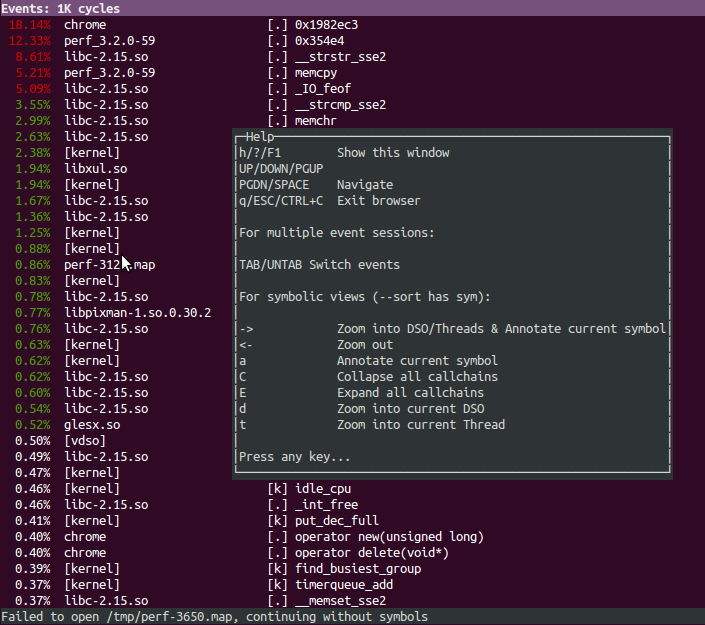
Using Linux perf for great CPU stats and seeing system performance


The perf command is a really good low-level Linux profiling tool.

You can use it to profile your programs ...


$ perf stat conv

 Performance counter stats for 'conv':

         18.600269 task-clock                #    0.970 CPUs utilized          
                13 context-switches          #    0.001 M/sec                  
                 8 CPU-migrations            #    0.000 M/sec                  
              1621 page-faults               #    0.087 M/sec                  
          34604515 cycles                    #    1.860 GHz                     [35.87%]
           3070113 stalled-cycles-frontend   #    8.87% frontend cycles idle    [28.97%]
           2557127 stalled-cycles-backend    #    7.39% backend  cycles idle   
          10234506 instructions              #    0.30  insns per cycle        
                                             #    0.30  stalled cycles per insn [96.18%]
           3765521 branches                  #  202.444 M/sec                   [75.68%]
            159957 branch-misses             #    4.25% of all branches         [54.80%]

       0.019182090 seconds time elapsed


But you can use it to profile the running system and then for example query who caused certain kernel lock events with the interaction "perf top" tool....


https://perf.wiki.kernel.org/index.php/Main_Page

https://access.redhat.com/site/documentation/en-US/Red_Hat_Enterprise_Linux/6/html/Developer_Guide/perf-using.html


31 January 2014

AMD unveils 64-bit ARM-based Opteron A1100 processors

There are quite a few stories about how AMD have released a very interesting 64-bit ARM-based Opteron CPU.  Is this a good step towards 64-bit ARM processors becoming common place in data centres?

Hexus: AMD unveils 64-bit ARM-based Opteron A1100 processors

The Register: AMD tries to kickstart ARM-for-servers ecosystem

15 January 2014

How the HP-UX C/C++ compiler can help with 64-bit porting

I'm going to write up some notes about various modern UNIX compilers, first up is the HP-UX compiler.

The HP-UX C/C++ compiler  is currently at version A.06.27, last updated in 2012. Since the creation of version 6, it seems to only have had a few tweaks made to it. For example, it lacks many new C++ features.

Nevertheless, it has some useful warning options that can help with migrating code to 64-bit goodness.


Compiler versions


$ cc -V
cc: HP C/aC++ B3910B A.06.27 [May 22 2012]
$ aCC -V
aCC: HP C/aC++ B3910B A.06.27 [May 22 2012]


A very simple example:

#include stdio.h
#include stdlib.h
#include string.h

int main(int argc, char *argv[])
{
    int len;
    char str[] = "Hello world, is this string okay?";

    len = strlen(str);

    printf("strlen is %d\n", strlen(str));

    return 0;
}

Interesting options that could help us


+w64bit      - Enables warnings that help detection of potential problems in converting 32-bit applications to 64-bit
+wlint       - Enables several warnings in the compiler that provide lint like functionality
+wperfadvice - Enables performance advisory messages.
+wsecurity   - Enables compile-time diagnostics for potential security violations

+w           - Warns about all questionable constructs

Some of these options are lint-like, some are useful performance tips, others help with code porting issues.

A normal compile gives no warning in the above example, but if we add these warning flags we get extra output:


$ cc strlen_example.c -o strlen_example +w64bit

"strlen_example.c", line 11: warning #4229-D: 64 bit migration: conversion

         from "size_t" to "int" may truncate value

       len = strlen(str);

           ^


more:


$ cc strlen_example.c -o strlen_example +w        

"strlen_example.c", line 11: remark #4229-D: 64 bit migration: conversion from

         "size_t" to "int" may truncate value

       len = strlen(str);

           ^


"strlen_example.c", line 13: remark #2181-D: argument is incompatible with

         corresponding format string conversion
       printf("strlen is %d\n", strlen(str));
                                ^

"strlen_example.c", line 8: remark #2550-D: variable "len" was set but never
         used
       int len;
           ^

Larger example output from some code that deals with large files:


"MyLargeFile.c", line 231: warning #4298-D: addition result could be truncated before cast to bigger sized type

"MyLargeFile.c", line 321: warning #4229-D: 64 bit migration: conversion from "size_t" to "int" may truncate value

"MyLargeFile.c", line 723: warning #4298-D: multiply result could be truncated before cast to bigger sized type

"MyLargeFile.c", line 3263: warning #4229-D: 64 bit migration: conversion from "unsigned long" to "unsigned int" may truncate value

"MyLargeFile.c", line 2423: warning #4229-D: 64 bit migration: conversion from "size_t" to "int" may truncate value

"MyLargeFile.c", line 3478: warning #4229-D: 64 bit migration: conversion from "unsigned long" to "int" may truncate value
"MyLargeFile.c", line 5134: warning #4229-D: 64 bit migration: conversion from "long" to "int" may truncate value
"MyLargeFile.c", line 5692: warning #4231-D: 64 bit migration: conversion between types of different sizes has occurred (from "int" to "void *" )


As you can see, the compiler can spot quite a few issues with this code that you might want to consider carefully when making a real 64-bit pure aware application.


External links:

HP aC++/HP C Online Programmer's Guide

Command-Line Options


13 December 2012

Updated Android SDK has Linux 64-bit ADT bundle

Maybe it was there previously, but this seemed new to me. I was exploring the updated:

developer.android.com/sdk/index.html

and saw that Linux 64-bit has a file download.  So 64-bit support is there for Mac OS X, Windows and Linux.

The new SDK is r21.

08 January 2012

Solaris Studio 12.3 compiler released

Another impressive compiler update. This is the first compiler to officially support the new Solaris 11
operating system. Solaris Studio 12.3 has many interesting updates:
  • support for SPARC T4
  • support for Sandy Bridge AVX
  • lots more...

Solaris Studio Overview

Register: Solaris Studio 12.3

Docs: What's new with 12.3

15 January 2011

Building a new powerful but efficient PC ... Part 3 Storage

It was hinted to me that a great set up for a new PC would be something like this :

small SSD for the OS
2 x 1TB drives, one for /home and the other for /virtual_machines


at the time of building my PC, the cost of SSDs seemed too high and I kept reading stories and articles about the short life of SSDs. Most stories revolved around requiring levelling to stop it writing to the same place over and over as they cannot do that for long.

In the end, I opted for something similar:

500 GB drive for the OS    (I struggled to find a drive this small!)
1 TB normal desktop speed (7200 rpm)  for /home
1TB eco drive (green) for /virtual_machines

I haven't had a problems so far, they are all very quick drives.

Since reviewing this set up, I would probably recommend a slightly different choice. I would still have the 500GB drive for the OS. But instead of 2 x 1 TB drives, I would recommend 3 x 1 TB drives and set them up in a software RAID. This would help if one of the drives fails, you could just get another and plug in to replace it and not lose any data.

10 October 2010

Sun Studio 12 update 2

Sun^H^H^HSolaris Studio 12 update 2 has been released.

This native Solaris compiler suite has had a lot of care and attention paid to it recently. It has received many impressive updates & new features recently.

This latest update renames the product from Sun Studio to Oracle Solaris Studio.

Highlights include :
+ Improved performance and improved code generation
+ Improved support for newer CPUs
+ Better diagnostics
+ Improved support for OpenMP & Linux
+ Many improvements to Performance Analysis tools & dbx
+ Improvements to DLight

Excellent highlight for me was the improvements to dbxtool and the inclusion of the brand new Discover memory debugging tool. It appears to be similar in functionality to Valgrind, which will be a great help when debugging Solaris apps.

What's new guide
Solaris Studio page

26 August 2010

KVM OpenSolaris

Although I deleted my old OpenSolaris VirtualBox VM, I thought I'd see if KVM could handle the last OpenSolaris 134 development release.
KVM worked work, it installed very well and runs fast. What impressed me the most was the 134 build itself. Everything was updated and better than the older 2008.05 release I was stuck using at work (My Xeon CPU would not boot the 2009.06 release, build 118 and above seem okay).
The Package Manager looks wonderful. I'm using it to install SunStudioExpress, to explore the new developer features.
I think that I will keep this VM around and reload Solaris 11 into it whenever that gets released.
I find that it is always useful to use compilers from different platforms to check the correctness of your code, and Sun Studio is a good compiler.

25 August 2010

Migrating to KVM

I've begun the process of migrating to the KVM virtualisation technology. I did have some reservations about it initially, because I felt that we should not have to deal with full machine VMs running legacy OSs like Windows and instead new VM technology should be focusing on para-virtualising many copies of GNU/Linux.
But I have been trying out KVM with each new GNU/Linux distribution and finally it is getting good. The speed and technology have always been good but the GUI side was lacking, but it has greatly improved.

On my Fedora 13 x64 system, KVM is very fast at creating brand new VMs. But what to do with my VMs that I have built up on VirtualBox ?

So far I've migrated 3 VMs using a command like this :

$ cd $HOME/.VirtualBox/VDI
$ qemu-img convert CentOS4_32-bit.vdi -O qcow2 CentOS4.qcow2

This will convert the VDI file into qcow2 for use in KVM. I'm sure that they are better ways to do this, but it worked for me for 3 VMs so far.

I miss a few features from VirtualBox, mostly the save current state which saves the VM and closes it all down, like a hibernate. I miss the graphical performance of VirtualBox which is fast. The Shared Folder support is also great.

But KVM is developing rapidly. The performance is great and much faster than any other VM product that I have tried. I can't wait to see how KVM develops in the future.

24 August 2010

OpenSolaris is killed off

I have been sad to see the demise of Sun. They were one of my favourite companies and were the leading innovators of UNIX. They gave so much to the industry and redefined it in so many ways.

With the new of the demise of OpenSolaris, I have deleted my OpenSolaris partition at work and deleted my VirtualBox VMs of OpenSolaris 2009.06 x64. It looks like they will have a Solaris 11 Express in the future but I'm not sure if I will try that.

The Register: OpenSolaris killed off

Oracle's attitude seems to have turn sour with news like this :
BBC News: Oracle sue Google
Will they be suing MS next for .NET ? which is just a Windows-specific copy of Java and the JVM.
How safe are MySQL, OpenOffice and VirtualBox?

12 June 2010

Sun Studio Express 6/10 released

A refresh to the excellent Sun Studio suite has been released.

The last full release (Sun Studio 12 Update 1) included a new DBX frontend called dbxtool, which was excellent.
This refresh includes an interesting new addition. It a new memory debugger called Discover.
They have also included brand new code coverage tools.
Also included is better optimisation support for new CPUs such as the Xeon 7500 range and the newer SPARC processors.
Performance analyser has been improved and the IDE is upgraded to NetBean 6.8 level.

Sun Studio download link at developers.sun.com
Video link

Previous Sun Studio 12 Update 1 included:

* DLight: runtime profiling using DLight, which unifies application and system profiling using DTrace technology on Solaris platforms.
* OpenMP 3.0 support, in the compiler and performance tools.
* Performance Analyzer: MPI Application Profiling
* Thread Analyzer: Detecting Multithreaded Programming Errors

Screencasts available here

19 May 2010

Building a new powerful but efficient PC ... Part 2

The Power Supply Unit (PSU)

I wanted to find a cheap but very good PSU for my PC building exercise. I had already decided that it had to be both silent and 80% efficient at a minimum. The 80plus program details devices that are at least 80% efficient, so look out for the 80PLUS badge.

The 80plus website is an excellent way to check out the specifications of a PSU that you are interested in.

http://www.80plus.org/manu/psu/psu_join.aspx

By browsing this list I was able to find a 500W PSU that was 85% efficient at 50% load, which is good enough for me as it was inexpensive. I opted for a Coolermaster 500W Silent Pro M.

25 April 2010

VIA unveils Nano E-Series 64-bit CPUs

VIA Unveils Nano E-Series at ESC 2010, Readies Embedded Industry for Next-Generation 64-bit Computing

Via: Nano E-Series

PCMag: Via unveils 64-bit Nano E-Series CPUs
Via 64-bit processors

24 April 2010

Building a new powerful but efficient PC

I've decided to build a new PC. The last time I did that was about 10 years ago maybe, when I built a dual CPU Pentium III with 512MB of RAM and 2x 20GB hard drives. Obviously, things have moved on a lot since then. I normally use a variety of CPU architectures and manufacturers at work, and work have settle for Intel CPU for desktop workstations. At home, for desktop PCs, my last two were HP AMD 64-bit Athlon machines. First the Athlon 64, then the Athlon X2.

I have been searching around for about 2 months online, checking out configurations and prices. But I struggled to find the exact specification that I wanted and struggled to find GNU/Linux only machines. It is probably my fault for being fussy, because I wanted efficiency to play a huge part. Why buy a CPU eating 125 watts of power when a 45W or 65W will be almost as quick?

I decided that I was either going for a really low power 45-65W machine, like the Dell Inspiron Zino HD, i.e. a small case and lower power but packing a punch with lots of RAM. Or, I was going to make a really powerful workstation that still did not require a local power station to run it. Well I opted for the powerful workstation because I wanted to make it last a while and run lots of virtualised guests.

After not finding what I wanted in the pre-built PC world, I decided to build one myself.

So far, I've only bought 3 parts, I'll buy the rest over the next weeks/months.

CPU: AMD Phenom II 905e
Motherboard: Gigabyte 785G chipset MA785GT-UD3H
and a nice case.

The reasoning behind the CPU, is that it is very powerful & has great virtualisation features, having 4 cores will future proof me a little. It is a very lower power consuming chip, it requires 65W, vs. the 125W of the Black editions and the fastest i7 from Intel. It has lots of cache also.

The 785G chipset seems very fast and has that great feature of having fast on-board graphics. I'll probably just stick with on-board graphics for a while. The board has some great eco-friendly features to keep it cool and running reliably. There is a slightly newer chipset but I thought this one was great and implemented well and should be very compatible with Linux.

Next step might be choosing a good quality PSU, hard drives or SSD, RAM, etc. etc.

04 September 2009

Being Virtualised

I noticed that RedHat released their 5.4 update and it includes a lot of new features.

h-online: RedHat Enterprise 5.4
Info.Week: Redhat virt

They seem to be really going to KVM instead of Xen, and now I'm starting to wonder if that is the right move. The more I use VirtualBox and KVM, the more I want to stop using legacy OSs like Windows. The main reason for VirtualBox, VMware and KVM, at the moment, is to do full hardware virtualisation. But we don't want to run and use Windows forever, the future is GNU/Linux.
Redhat already has a great solution for para-virtualisation, where you can easily runs hundreds of VMs with little slow down, and it's called Xen.

So just when I start to think that the days of VirtualBox, VMware and KVM are limited, it seems that others are saying that they are the future. Why? Do the believe that we'll be needing those legacy OS's forever? I'd rather be able to run a few Linux distributions at once without needed full HW-virt.

Just a thought.

21 August 2009

OpenSolaris 64-bit kernel 118 boots again

I'm happy again after trying out the OpenSolaris build 118 kernel from www.genunix.org

It now boots up successfully on my Quad-core Xeon E5410 processor. OpenSolaris 2008.05 was the last version that booted up okay, the subsequent versions would just automatically reboot just after loading the kernel. I tried different kernel debugging options but they all resulted in it just rebooting before giving any useful information.

But after grabbing "OpenSolaris preview 2010.02, based on build 118" from genunix.org, it boots successfully. So I will be very happy to use the 2010.02 release once it becomes available.

genunix.org
http://www.genunix.org/

News round up: 64-bit Chrome appears?

CNET: Google's 64-bit Chrome starts emerging--on Linux
http://news.cnet.com/8301-30685_3-10314452-264.html

What's 64-bit on Snow Leopard?
http://www.pcworld.com/businesscenter/article/170478/whats_64bit_on_snow_leopard.html

FreeBSD 8.0 Beta 2 64-bit (AMD64)
http://lists.freebsd.org/pipermail/freebsd-stable/2009-July/051181.html

Ubuntu 8.04.3 LTS 64-bit release
https://lists.ubuntu.com/archives/ubuntu-announce/2009-July/000124.html

NetBSD 5.0.1 64-bit release
http://www.netbsd.org/releases/formal-5/NetBSD-5.0.1.html

23 July 2009

Power7 CPU news

Slashdot: Power7
http://it.slashdot.org/story/09/07/22/1828249/POWER7-To-Ship-In-First-Half-of-2010

TheRegister: IBM lifts the veil on Power7
http://www.theregister.co.uk/2009/07/21/ibm_power7_details/

zdnet: IBM outlines Power7 plans
http://news.zdnet.co.uk/hardware/0,1000000091,39689359,00.htm

Easy upgrade path to Power7
http://www.itbusinessedge.com/cm/blogs/cole/an-easy-path-to-the-power7/?cs=34310

Going from distrib to distrib

I ended up using Ubuntu 8.04 64-bit as my work desktop for possibly 10 months. I chose this after failing to get newer OpenSolaris release to boot on my quad-Xeon CPU (latest 104 Solaris kernel still does not boot).

Ubuntu is excellent, I'm quite used to Debian and Ubuntu at home, so setting them up at work was easy. Showing off apt-get to people really impressed them. I did have issues with being stuck on openoffice v2, but I could cope with that. I did want to try out the KVM virtualisation technology, but that was quite lacking in Ubuntu; it never started up properly or worked.

I wanted to switch to a distribution that was more KVM friendly so I decided to wipe Ubuntu and go with CentOS 5.3. But waiting for 5.3 took too long for me, so I went with Fedora 10 64-bit :-).
I've used all the distros at some time, so Fedora was not new to me. It is an excellent distro.
I had only a couple of issues with it :
1) nvidia driver problems - resolved by adding another repository source
2) constant yum issues - the PackageKit would hang and lockup all the time
3) yum is nowhere near as good as apt

But I've been very happy with Fedora 64-bit. It has everything I need in a corporate development environment. The other developers using Windows are constantly surprised at Fedora features.

Since then, I have upgraded to Fedora 11, which is even better. But I would not recommend the upgrade, you should format and install the new Fedora 11 fresh. I've had lots of issues with clashing packages and dependency problems, but I have resolved them all. PackageKit now works.
and I've been experimenting with KVM vs. VirtualBox 3.0.2.

03 July 2009

Sun Studio 12 Update 1 released

A new compiler refresh from Sun. It's the Sun Studio 12 Update 1.
For me, it fixes an optimisation bug that prevented me using Solaris on x64. so I'm very impressed so far.
This update changes a lot from the original Studio 12, original Studio 12 was v5.9, Update 1 has a new 5.10 version number.
dbxtool is new and the IDE has been updated also.

Features
Sun Studio 12 Update 1 Download
Support Matrix

27 May 2009

Open64 compiler suite

x86 Open64 Compiler Suite v4.2.2 is now available.

It appears to be a complete & open compiler suite for x86 32-bit & 64-bit machines.
It looks very feature rich. The downloads are only for GNU/Linux.

Open64 compiler suite

25 March 2009

New Linux released 2.6.29

The kernel called Linux has reached version 2.6.29.
It contains a huge amount of new development and interesting features.

KernelNewbies: 2.6.29
IBM developerWorks: Linux kernel advances

04 February 2009

Manually enabling the new 64-bit Java plugin

I found that I had to do the following to enable the new Java 6 Update 12 64-bit plugin, which was just released as part of Java 6 Update 12.

$ cd /usr/lib/firefox-3.0.5/plugins
$ sudo ln -s /opt/jdk1.6.0_12/jre/lib/amd64/libnpjp2.so .

Then restarting Firefox & doing "about:plugins" correctly showed the Java plugin as loaded up.

08 December 2008

OpenSolaris 2008.11 released

Lots of new features in this excellent new OS release. They include
  • GNOME 2.24
  • ZFS
  • TimeSlider
  • Firefox 3
  • Songbird
  • New packaging updates
  • Desktop Search
  • OpenOffice 3
  • Suspend/Resume to RAM for some laptops
  • Update notifier
  • New software in the repository
  • Better network setup
  • Better support for more hardware


opensolaris: What's new

Release Notes

OpenSolaris Killer Feature
www.opensolaris.org
www.opensolaris.com

osnews: OpenSolaris 2008.11 released

28 July 2008

Don't forget about Lint

The lint utility that is supplied with Sun Studio 12 has some great features for analysing and diagnosing source code problems. Lint is a static source code analyser, but has large fallen out of fashion due to developers relying on compiler diagnostics.

Indeed, having your source run on a variety of UNIX platforms is a great way to uncover issues. I regularly have to compile the same code on Solaris, RedHat AS 5, Ubuntu, Debian, HP-UX, HP-UX Itanium & AIX.

The various compilers do have excellent warnings and that's worth exploring as a project, some of them have great 64-bit checking options.

Sun Studio Lint has some wonderful options for diving into your source code to do that extra thorough analysis. It can uncover 64-bit porting problems and something I didn't know, was that it can try to find security problems also.

Example output:

(34) warning: possible ptrdiff_t overflow
(242) warning: format argument to sprintf() contains an unbounded string specifier
(252) warning: format argument to sprintf() contains an unbounded string specifier
(319) warning: possible ptrdiff_t overflow
(324) warning: possible ptrdiff_t overflow

So it can detect the following potential problem :
"Use the -errsecurity option to check your code for security loopholes."

char buffer[80];

sprintf( buffer, sizeof(buffer)-1, "%c%d%d%s%d", ch, i1, i2, filename, i3 );


where it's saying that the filename string isn't limited and could overrun the buffer. One fix would be to change to use "%.*s" rather than "%s".

Sun Studio docs for Lint

10 July 2008

OpenSolaris 2008.05 ISOs To Be Updated

It looks like the ISOs are to be updated soon, that's great news. I hope it improves it a lot. I am using Ubuntu 8.04 64-bit and it is really good, but living without a good developer environment like SunStudio and great tools like DTrace is really difficult. Java JNI debugging on Linux is almost impossible, it's a dream on Solaris. I hope to download the later ISOs and reinstall the OS.
But using Ubuntu 8.04 64-bit has been a good experiment at work, it's good to not have to put up with Windows.

Phoronix: OpenSolaris 2008.05 ISOs To Be Updated

18 June 2008

OpenSolaris 2008.05

I gave this edition a serious try at work. I installed it as my main desktop development platform on my shiny new multi CPU machine.
It installed fine, but the niggle there is that you cannot configure the installation at all. I wanted a partition on my 2nd drive to be /home but I could not do that.

After usage for a while, ZFS seemed brilliant, very powerful, it could easily add a second drive but not a partition. I had to give up and mount it as a directory after formatting it as UFS.

The environment itself is great, I did "pkg install sunstudioexpress" and 600MB later it was all installed and setup. For work it's much better than Ubuntu/Redhat etc. because of ZFS, DTrace and SunStudio, they are real killer features.

The problem came when I accidentally read that you can update the system via "pkg image-update", it really screwed up the system. I had multiple GRUB boot items, it went from 2 to 10 and some would not boot. Then nothing would link because of missing symbols, I've since read that that could be fixed. Upon trying to follow some proper instructions that describe the image-update isn't fully working yet, I tried to fix everything but ended up with a system that I could not boot.

So for now I had to re-format and load Ubuntu 8.04 64-bit instead.

But I eagerly await the next release so that I can use DTrace and SunStudio natively.

24 May 2008

OpenSolaris 2008.05 is released

An exciting new distribution from Sun has been released.
It seems like a very Free Software friendly version of Solaris. It has lots of great features such as :
  • ZFS
  • DTrace
  • Xen
  • IPS (Package Management System)
  • LiveCD

I tried the LiveCD on my R61i laptop and it worked well. I'm going to run OpenSolaris in 64-bit mode as my main desktop environment at work, DTrace and ZFS sound extremly useful.

OpenSolaris.com
OSNews: OpenSolaris shows promise
Slashdot: OpenSolaris released

28 April 2008

Ubuntu 8.04 64-bit release

Ubuntu GNU/Linux 8.04 released

Ubuntu Download

Both desktop and server editions have a 64-bit download, this release has Long Term Support (LTS).

Ubuntu 8.04 LTS Desktop Edition - Supported to 2011
Ubuntu 8.04 LTS Server Edition - Supported to 2013

for 64-bit AMD and Intel computers.

I haven't yet tested the 64-bit released, but the 32-bit release is fantastic, everything worked perfectly & ran extremely fast.

03 March 2008

FreeBSD 7.0 released

FreeBSD 7.0 released.
Lots of new features, check out the release notes.

DistroWatch News: FreeBSD 7.0

FreeBSD: Announcement
FreeBSD: Release Notes

64-bit ISO is roughly 500 MB.
7.0-RELEASE-amd64-disc1.iso (499MB)

Slashdot: FreeBSD 7.0 released
onlamp: What's new in FreeBSD 7.0

14 February 2008

OpenSolaris Indiana Developer Preview 2 released

DistroWatch: Indiana

Indiana Preview 2 Released.
I must say that it is excellent. I booted from it and ran it as a live CD. It was extremely fast & stable. I look forward to its final release.

Phoronix: Tour of Indiana Preview 2

Solaris Express Developer Edition First Impressions

First Impressions

First impressions of the new SXDE are pretty good.
The upgrade process took around 1 - 2 hours, it fully upgraded to the latest release and the process worked a lot better than the previous versions upgrade system.

I rebooted (after sorting out my grub menu) and it seemed just as stable as the previous release. I'll use it properly soon. It certainly did upgrade the Sun Studio compilers and now NetBean is version 6.0, which is great.

Solaris Express Developer Edition Download

Solaris Express Developer Edition Free DVD

I tried out the free DVD option on the Sun website, I highly recommend it. The free delivery of the SXDE DVD only seemed to take a couple of business days.

05 February 2008

Solaris Express Developer Edition 1/08 released

Another refresh of this excellent Solaris 64-bit edition.

Solaris Express Developer Edition

Lots of new features :

Solaris Express Developer Edition : Features

including:
New Sun Studio Express
NetBeans 6.0
Solaris (Solaris Express Community Edition build 79b)
and lots lots more.

11 December 2007

New Valgrind 3.3.0 released

3.3.0 primarily contains tool enhancements: a restored and improved version of Helgrind (thread checker), majorly revamped version of Massif (space profiler), branch-mispredict profiling for Cachegrind, and new experimental tools (Omega and DRD). Also includes support for recent Linux distros (Fedora 8, openSUSE 10.3), scalability improvements (for gigabyte-sized applications), modestly improved documentation, fixes for 56 bug reports, experimental support for AIX5.3, and many minor refinements.


Valgrind current releases
Valgrind 3.3.0 release notes

06 November 2007

IBM Power6 news

IBM is soon to launch the new 64-bit Power6 CPU.

VNU article : IBM bets on Power 6, AIX and virtualisation trinity

16 October 2007

03 October 2007

AMD Performance Library update 1.1

AMD Performance Library update

APL Product Features

New! Video Decoding (H.264) support
New! JPEG support
New! AMD “Barcelona” Processor Optimizations
New! Sun Studio for Solaris support

24 September 2007

Solaris Express Developer Edition 9/07

Another great new release of this excellent Solaris edition.

Solaris Express Developer Edition

Lots of new features :

Solaris Express Developer Edition : Features
Solaris Express Developer Edition : Tech FAQ

including:
  • Sun Studio 12 C, C++ and Fortran compilers and NEW D-Light, a GUI DTrace tool that simplifies using DTrace
  • NetBeans 5.5
  • Solaris (Solaris Express Community Edition build 70b)
  • A superb new installer
  • Updated GNOME and lots lots more...

This is an excellent distribution from Sun, amazing useful for developers. I install it on an x64 system and it goes on in 64-bit mode, but you can boot it in 32-bit mode also. I assume it can install on 32-bit x86 but I haven't tried that.

Sun Solaris Express Developer Edition Gets Usability Makeover

Update It seems excellent, my sound is now working. Overall the system feels faster.

23 September 2007

New Project Indiana Details Emerge

Phoronix reports about new Project Indiana details.

It seems like it is going to be the new OpenSolaris (32-bit & 64-bit). It looks great and I cannot wait to use it.
For debugging Java JNI, GNU/Linux is pretty much useless right now, because gdb cannot use the new thread model. But using Solaris or OpenSolaris dbx debugs perfectly.
The Solaris Developer Edition 64-bit is a great OS for the time being, and will probably get updated shortly with a new kernel and new tools, look forward to that also.

Phoronix: New Project Indiana Details Emerge

10 September 2007

AMD unveil new Quad 64-bit CPU

64-bit Quad-Core with: 64-bit with great performance, with enhanced performance per watt, and improved virtualisation.
The new chip has better a floating point architecture, a new memory optimiser to help with memory throughput on multi cores, hugely improved power management, and a smarter cache, and more.

More here : AMD Multi Core

ZDNetAsia: AMD unveils Barcelona chip
CRN: AMD launches Quad-Core
BetaNews: Quad-Core
BetaNews: AMD new power metric

AnandTech Quad Benchmarks

26 August 2007

64-bit Java coming to Mac OS X Leopard

64-bit Java coming to Mac OS X Leopard

This is great news. The link provides more info. Basically it's 64-bit and resolution independent.

News link

07 August 2007

New faster UltraSPARC T2 released

Features : 8 cores and 64 threads on one chip, integrated 10 GbE networking, crypto, and PCI-Express expansion.
Huge improvements in all CPU areas, from increased integer & floating point performance increases to more threads and more integrated components.

Sun: UltraSPARC T2
Sun: UltraSPARC T2 Features
TheRegister: UltraSPARC T2

29 July 2007

64 Studio 2.0 released

DistroWatch reports that 64 Studio 2.0, aka "Electric", has been released. It's a Debian based 64-bit GNU+Linux.

DistroWatch entry 64 Studio
64Studio.com link
64Studio Press Release

24 July 2007

GCC 4.2.1 released

The GNU project and the GCC developers are pleased to announce the release of GCC 4.2.1

This release is a major release, containing new features (as well as many other improvements) relative to GCC 4.1.x.

GCC 4.2
GCC 4.2 changes

GCC 4.2.1 will be the last release of GCC covered by version 2 of the
GNU General Public License. All future releases will be released
under GPL version 3. See:

http://gplv3.fsf.org

for more information about GPLv3.

13 July 2007

Enabling Solaris 64-bit C++ warnings

To enable Sun Studio to print out full C++ 64-bit porting warnings you need to use +w & -xport64. I found that -xport64 on its own didn't do anything.
+w        Print warnings about additional questionable constructs
-xport64 Enable extra checking for code ported from 32-bit to 64-bit platforms

The warnings are extremely useful in cleaning up C++ code with regards to 64-bit portability.

Another useful option is :
+w2        Emit warnings for code with additional portability problems

See "CC -flags" for full options and usage.

24 June 2007

AMD to introduce 45nm process AM3 CPU family in 2H08

AMD to introduce 45nm process Socket AM3 CPU family in 2H08

It also looks like they might drop the "64" from the name of some future CPUs, but they will still of course all be fully 64-bit.

Source: Digitimes

16 June 2007

Intel Itanium to skip 45nm

Intel's high end 64-bit chip, the Itanium, to skip over 45nm and go straight to 32nm.
It's going to get more powerful & have more features such as quad-core.

Source: vnunet

12 June 2007

Solaris Express Developer Edition 5/2007

A new release of this excellent Solaris edition.

Solaris Express Developer Edition

Lots of new features :

Solaris Express Developer Edition : Features

including:
New Sun Studio 12 C, C++ and Fortran compilers
Solaris (Solaris Express Community Edition build 64a)
and lots more.

Apple shows off new Leopard developer features

Xcode 3.0 has full 64-bit support, Xray looks exciting.
Leopard has DTrace
Leopard Developer

Leopard is fully ground-up 64-bit:
Leopard 64-bit

Engadget link Leopard 64-bit

07 June 2007

Sun Studio 12 released

"Sun Studio software delivers high-performance, optimizing C, C++, and Fortran compilers for the Solaris OS on SPARC, and both Solaris and Linux on x86/x64 platforms, including the latest multi-core systems"

Lots of new features including :
  • Supports Linux
  • Better x86-64 support
  • New Sun Studio IDE
  • Better multicore support
  • Faster compiler and better code generation

Sun Studio 12
What's new

01 June 2007

Fedora 7 released

New Fedora 7 release

New features include :
  • Linux 2.6.21
  • GNOME 2.18 and KDE 3.5.6
  • Xorg Server 1.3
  • Better KVM support
  • New Wireless stack

Fedora Project
Fedora 7 Release Notes

Torrent links
including x86_64 DVD and x86_64 Live

20 May 2007

AMD Performance Library 1.1 Preview

The Inquirer: AMD comes up with K10 performance library

AMD Developer Central

AMD Performance Library 1.1 Preview helps performance especially for 64-bit CPUs.

The next Windows Server will be 64-bit only

OSNews Link : The next Windows Server will be 64-bit only

It looks like the next version of Windows Server will be 64-bit only. That's a pretty good step.

Betanews: Windows Server 2008 to be the last 32-bit server Windows OS

14 May 2007

GCC 4.2 released

The GNU project and the GCC developers are pleased to announce the release of GCC 4.2.0.

This release is a major release, containing new features (as well as many other improvements) relative to GCC 4.1.x.

GCC 4.2
GCC 4.2 changes

13 April 2007

CentOS 5.0 released

Release for CentOS-5 i386 and x86_64

New features highlights :

  • These updated software versions: Apache-2.2, php-5.1.6, kernel-2.6.18, Gnome-2.16, KDE-3.5, OpenOffice.org-2.0, Evolution-2.8, Firefox-1.5, Thunderbird-1.5, MySQL-5.0, PostgreSQL-8.1.
  • Better desktop support with compiz and AIGLX.
  • Virtualization provided by the Xen hypervisor with Virtual Machine Manager and libvirt.

CentOS website
CentOS 5.0 Release announcement
Distrowatch: CentOS

12 April 2007

Microsoft 64-bit website refresh

It looks like Microsoft has updated it's 64-bit section.

Microsoft 64-bit Computing Overview

09 April 2007

Debian 4.0 released for AMD64

The new Debian 4.0 release of today officially supports AMD64 :
A total of eleven architectures are supported including: Sun SPARC (sparc), HP Alpha (alpha), Motorola/IBM PowerPC (powerpc), Intel IA-32 (i386) and IA-64 (ia64), HP PA-RISC (hppa), MIPS (mips, mipsel), ARM (arm), IBM S/390 (s390) and – newly introduced with Debian GNU/Linux 4.0 – AMD64 and Intel EM64T (amd64).

New features include :
  • Linux kernel version 2.6.18
  • GNOME 2.14
  • Xfce 4.4
  • OpenOffice.org 2.0.4a
  • Evolution 2.6.3
  • the GNU C library, version 2.3.6
  • the GNU Compiler Collection 4.1 as default compiler
  • language interpreters: Python 2.4, PHP 5.2
  • web servers: Apache 2.2, fnord 1.10
  • database servers: MySQL 5.0.32, PostgreSQL 8.1

Release Notes
Debian GNU/Linux 4.0 released
Distrowatch entry : Debian
OSNews : Debian 4.0 released
Debian 4.0 (etch) review

26 March 2007

New 64-bit Linux releases

SabayonLinux 3.3 64-bit miniEdition
The single-CD "miniEdition" of SabayonLinux 3.3 has been released

64-Studio
Audio focused 64-bit Linux distribution.

Beta Ubuntu 7.04 "Fiesty Fawn" released

HP tool update

New Release! HP Code Advisor C.01.15 is now available for free download.

The following are the notable features of this release:

* Generate code complexity metrics to gauge the complexity of the code being developed or migrated
* Detect multi-thread programming issues
* Create easily manageable snapshots of the PDB
* New options for finer control of the diagnostics at individual module and macro levels
* Improved cross-file analysis time
* Enhancements to the -crossfile option for selective enablement
* -target option to help reduce build to only modified elements
* Enhancements to reporting, including generation of HTML report

HP C Advise

Like "lint", this tool seems great at running some more thorough code analysis. I recommend running this if you have HP Itanium systems.

20 March 2007

Solaris Express Developer Edition 2/07

Sun has a great new edition of Solaris aimed at developers.

"Solaris Express Developer Edition is an OpenSolaris-based distribution for x86 that includes the latest tools, technologies, and platforms to create applications for Solaris OS"

It includes Sun Studio 11 pre-installed, as well as NetBeans & Web 2.0 tools, StarOffice 8.0, Solaris + AMP and much more. The OS is Solaris Express Community Edition build 55. This edition is x86 only.

There is also a VMware packaged edition on the link below. I tested that 64-bit download in VMware Server and it worked really well.

Sun Developer Site : Solaris Express Developer Edition
Sun Developer Site : Download Page

13 March 2007

AMD/ATI losing the geeks ?

When AMD introduced the Athlon, everyone seemed to notice, but especially the geek crowd. It was a great new processor. When they introduced the Athlon64 and Intel stated that 64-bit was not in their desktop future, the geeks and techies went crazy for AMD. It's been hugely successful and AMD64 is a great architecture. It almost feels like amazing good Alpha CPU didn't die, in some ways it's lived on in the AMD64.

The pendulum swung in favour of AMD and stayed there.

Intel backtracked and then copied the AMD64 and called in EM64T. But Intel were in a mess, developers, geeks and techies wanted fast 32/64-bit capable Athlon64 chips and didn't want the high power usage Pentium4. Company trouble at Intel also made things worse for them, layoffs occurred to try to sort things out.

But....

Geeks have respect for Intel again after it ditched the Pentium4 and released the Core CPU. The Core is a great CPU, lower power usage & very fast performance. Core Duo in a latop out performs the fastest AMD laptop CPU (Turion64). But it didn't stop there, they released desktop and laptop Core Duo CPUs and then enabled 64-bit CPUs for all via the Core 2 Duo. Core 2 Duo is even faster and even more energy efficient. I can understand why Apple switched to it (although it has taken me a long time to accept it & then try to understand why, I liked PowerPC).

Intel have raised the stakes yet again by releasing a Xeon 64-bit Quad CPU that uses 50W
Intel Xeon
The Register : New Xeon


I think that AMD made improvements, some of the dual core Athlon X2 CPUs use less or the same power as the old single core CPUs. But at the same time, Intel introduced a new CPU architecture and then improved upon it with the Core 2 Duo. AMD should have had the K8L out and ready, it does look interesting.

Drivers
Linux people that want to try out the great looking features of Beryl/Compiz etc. they are finding that ATI does not support this in their binary driver. Linux devs and users are being forced to switch to Intel (open source driver) or NVidia (binary driver supports AIGLX) instead.

02 March 2007

VMWare Fusion Beta 2

arstechnia reports VMWare Fusion Beta 2 comes with "Experimental 3D Acceleration"

I'm not personally interested in 3D support, but it looks like it's going to be a great product. It does support 32-bit and 64-bit guests, which Parallels does not. The 64-bit support in VMware Server is excellent, I would expect that support in Fusion to be good also.

28 February 2007

Win64: slow progress

I was looking through an XML library this week. It's one that compiles on various UNIX platforms, and Mac OS X and Windows. Primarily it's been built for Windows 32-bit, but it has been built for 64-bit UNIXs so I thought that the code would be code and ready for Windows 64-bit.

I was a little surprised to find that it was not anywhere near ready. I think the authors had assumed that the UNIX LP64 programming model is the same as the Windows 64-bit LLP64 programming model.

Variable sizes in 32/64-bit modes :
          32bit   LP64    LLP64
int 4 4 4
long 4 8 4
void * 4 8 8
HANDLE 4 8 8

Maybe it's the fact that in LLP64, the size of a long is different from LP64 that is confusing some development, but the compiler does help. With VS2005, if you try to put a pointer into a long it flags an error.
Another issue is HANDLE, which I have mentioned before.
I found hundreds of such errors when building this XML library. I think it will take a while for Windows developers of native code to catch up to VS2005 and then to catch up to 64-bit.

08 February 2007

Intel Article on multithreaded programming

Intel: Nuts and Bolts of Multithreaded Programming

Get the basics about parallel algorithms, parallel programming APIs, and the tools required to start writing your own parallel programs.

Article: Moving to Windows Vista x64

CodeProject: Moving to Windows Vista x64

A very interesting & technically detailed article about 64-bit programming on Vista x64.

23 January 2007

New Valgrind 3.2.3 released

Release 3.2.3 (29 Jan 2007)

Updated to fix some problems with recent 3.2.2 release.

This tool is amazing for error checking C and/or C++ programs both in 32-bit and 64-bit mode.

Valgrind 3.2.3
Valgrind news

04 January 2007

New site found

start64 seems to be a great website for general 64-bit news and news of 64-bit software updates.

02 January 2007

LFS: a stepping stone to pure 64-bit software

One way to progress to pure 64-bit clean source code, is to add LFS support to your 32-bit code base.
Large File Specification (LFS) is a way of getting 64-bit file handling into your 32-bit code base.

Basically, you need to rebuild your 32-bit code with the following flags passed to your C and/or C++ compiler :

-D_LARGEFILE_SOURCE -D_LARGEFILE64_SOURCE -D_FILE_OFFSET_BITS=64

I've found this to work on every UNIX that I have encountered.

When enabled, all of your 'off_t' variables will be 64-bits wide.
Also you calls to fseek maybe mapped to fseek64 etc.

You should enable this and then work on updating your code base to handle it. You would have to do this anyway for pure 64-bit support.

Links
Wikipedia: LFS

01 January 2007

Ubuntu performance : 32-bit vs 64-bit

Phoronix : Ubuntu: 32-bit v. 64-bit Performance

They compare the latest version of Ubuntu and a beta release, to test 64-bit vs. 32-bit performance at various tasks.

21 December 2006

Ubuntu 6.10 64-bit release: Revisited

I finally installed this release after debating for a while.
I have to say, it's the best 64-bit GNU/Linux that I have ever used. Superb from boot up to shutdown :-)

It's by far the fastest Linux that I have used, very snappy and responsive. The ATI driver support worked really well, it installed fine and my ATI X1300 Pro works very well.
Support seems excellent, the documentation on ubuntu.com is really helpful.

So far, it seems much more polished than openSUSE 10.2 which I installed at the same time. 10.2 is pretty poor in comparison to Ubuntu 6.10.

I look forward to new Ubuntu releases.

Highly recommended.

08 December 2006

07 December 2006

Updated Apple 64-bit support

Apple Developer : Leopard Developer Application Technologies Overview

Above link has lots of information about changes for Leopard. Most of the interesting 64-bit stuff is near the end.

"Leopard brings complete 64-bit support to all of the Mac OS X frameworks"

30 November 2006

Linux: 64 Studio 1.0 released

Desktop Linux reports that 64 Studio 1.0, aka "Olympic, has been released. It's a Debian based 64-bit Gnu/Linux.

DistroWatch entry 64 Studio
64Studio.com link
64Studio Press Release

29 November 2006

14 November 2006

Windows PowerShell 1.0 64-bit

Windows PowerShell 1.0 for 64-bit appears to have been released.

Downloads for Windows XP 64-bit & Windows 2003 x86 64-bit & Itanium.
Download link

08 November 2006

More Vista 64-bit

Vista x64 build 5744 (RC2)

It's another improvement for Vista. Smoother & faster then RC1. It found all of my hardware again, and is working well. Installation was just as quick & painless.
I opted to reformatting the Vista partition and installed fresh.
The 3D stuff works well, it's a bit gimicky, but it works. I've found that most companies I've seen just switch to Classic, so a lot of those features will be lost on them.

Now that Vista has gone to manufacturing, I imagine they've done more incremental improvements. This build goes further in speed & seems more polished. It's still not as fast as XP on the same machine, but it's a good improvement.

28 October 2006

Ubuntu 6.10 64-bit release

Ubuntu GNU/Linux 6.10 released

There is an AMD64 ISO for both deskop and server AMD64 and are available at the download mirrors

Update: I could not install it. There appears to be an installer bug relating to "no root partition" message. It seems that the installer does not like to reuse a previous Linux OS partition and refuses to recognise it.

27 October 2006

AMD 64-bit chip lists

Here are a couple of links to AMDs list of 64-bit chips.
You can compare model numbers, cache sizes, thermal requirements, etc.

Mobile Turion 64 chips
Turion X2 Dual-core model numbers

Compare desktop chips
AMD 64-bit Processors for desktops

23 October 2006

Apple: 64-bit Leopard developer news

Leopard Technology Overview details some developer highlights from the upcoming "Leopard" Mac OS X 10.5.

The new developer tools like XCode 3.0 and xray (new GUI tool built on DTrace) do look impressive. There seems to be a large 64-bit update to various libraries and frameworks.

10 October 2006

News items

PC World - IBM Cranks Up Its Server Chip, Forthcoming Power6 chip pushes speed to 5.0GHz

ComputerWeekly - Itanium poses the 64-bit question

Computer Weekly - VMware offers 64-bit virtualisation support

The Register - VMware does 64-bits in full

Porting Article - Extend your application's reach from 32-bit to 64-bit environments

IT Business - AMD to push 64-bit computing with approved motherboard platforms

05 October 2006

News link: The Long Road to 64-bits

ACM Queue has an interesting article about the move to 64-bits

Article